E (Compound Interest Definition)
Colorized Definition
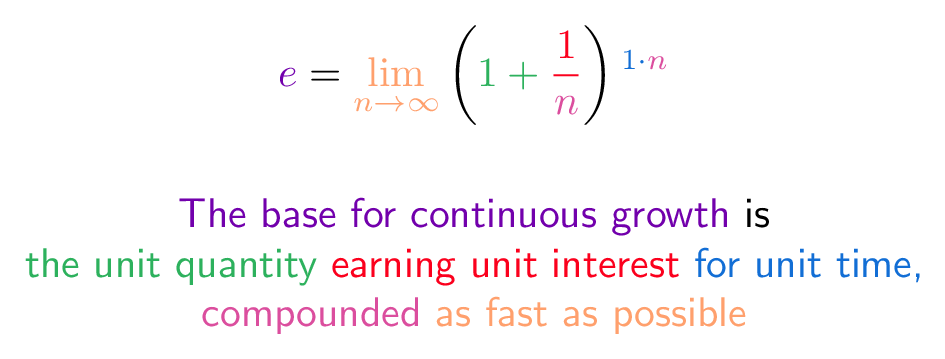
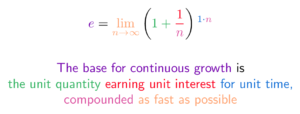
 \growth The base for continuous growth
\plain is
\\
\unitQuantity the unit quantity
\unitInterest earning unit interest
\unitTime for unit time,
\\
\compounded compounded
\perfectly as fast as possible
Plain English
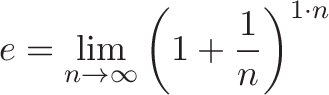
What is e? A constant (2.718...) representing continuous unit growth: the unit quantity (1.0), continuously growing the unit rate (100%), for unit time (1 period).
Why's e special? All circles are the unit circle, scaled up. All continuously growing systems are e^{rt}, scaled to some rate and time.
When should I use e? Use e^{rt} for things that change constantly (radioactive decay, populations). For growth based on discrete intervals (interest payments, combinatorics), (1 + rate)^{time} is a better model.
## Read More
- [An Intuitive Guide To Exponential Functions & e](https://betterexplained.com/articles/an-intuitive-guide-to-exponential-functions-e/)
- [Common Definitions of e (Colorized)](https://betterexplained.com/articles/definitions-of-e-colorized/)
- [Q: Why is e special? (2.718..., not 2, 3.7 or another number?)](https://betterexplained.com/articles/q-why-is-e-special-2-718-not-other-number/)